100% Pass 2026 AE-Adult-Echocardiography: AE Adult Echocardiography Examination Fantastic Questions Pdf
Wiki Article
BTW, DOWNLOAD part of PassReview AE-Adult-Echocardiography dumps from Cloud Storage: https://drive.google.com/open?id=1jd-qJLEJ4QQs8H16GMAjVtFF5RM_cd2j
Looking for customizable AE Adult Echocardiography Examination (AE-Adult-Echocardiography) practice exams? Look no further than PassReview! Our desktop and web-based practice exams allow candidates to set their own schedule and choose which ARDMS AE-Adult-Echocardiography questions to include in the exam. With a real exam environment, our practice tests help test takers prepare for the test pressure they will face during the final exam. Don't leave your success to chance - choose PassReview for your AE Adult Echocardiography Examination (AE-Adult-Echocardiography) practice exams.
ARDMS AE-Adult-Echocardiography Exam copyright Topics:
| Topic | Details |
|---|---|
| Topic 1 |
|
| Topic 2 |
|
| Topic 3 |
|
| Topic 4 |
|
| Topic 5 |
|
>> AE-Adult-Echocardiography Questions Pdf <<
Pass Guaranteed ARDMS - Efficient AE-Adult-Echocardiography - AE Adult Echocardiography Examination Questions Pdf
You can easily install ARDMS AE-Adult-Echocardiography exam questions file on your desktop computer, laptop, tabs, and smartphone devices and start AE Adult Echocardiography Examination (AE-Adult-Echocardiography) exam dumps preparation without wasting further time. Whereas the other two ARDMS AE-Adult-Echocardiography Practice Test software is concerned, both are the mock AE Adult Echocardiography Examination (AE-Adult-Echocardiography) exam that will give you a real-time AE-Adult-Echocardiography practice exam environment for preparation.
ARDMS AE Adult Echocardiography Examination Sample Questions (Q39-Q44):
NEW QUESTION # 39
Which murmur will occur in a patient with a ruptured papillary muscle?
- A. Early systolic
- B. Ejection systolic
- C. Late systolic
- D. Holosystolic
Answer: D
Explanation:
Rupture of a papillary muscle leads to acute mitral regurgitation, producing a holosystolic murmur heard throughout systole. This murmur results from backward flow of blood from the left ventricle to the left atrium during systole.
Ejection systolic murmurs are typically due to outflow obstruction like aortic stenosis. Early or late systolic murmurs occur in specific valve lesions but not with papillary muscle rupture.
This is covered in the "Textbook of Clinical Echocardiography, 6e", Chapter on Mitral Valve Disease and Mechanical Complications of Myocardial Infarction#20:430-435Textbook of Clinical Echocardiography#.
NEW QUESTION # 40
Which mitral valve filling pattern is characterized by a long deceleration time and an E/A ratio of 0.6?
- A. Pseudonormal
- B. Impaired relaxation
- C. Restrictive
- D. Normal
Answer: B
Explanation:
The mitral valve filling pattern characterized by a long deceleration time and a reduced E/A ratio (less than 1, such as 0.6) is consistent with impaired relaxation. This pattern is typically seen in early diastolic dysfunction, where there is slowed ventricular relaxation, resulting in reduced early diastolic filling (E wave) and a compensatory increase in atrial contraction contribution (A wave).
Impaired relaxation pattern shows:
E/A ratio < 1 (e.g., 0.6)
Prolonged deceleration time (>200 ms)
Prolonged isovolumic relaxation time (IVRT)
This pattern differs from restrictive filling, which has a high E/A ratio (>2), shortened deceleration time (<150 ms), and elevated left atrial pressures. Pseudonormal filling has a normal or near-normal E/A ratio but elevated filling pressures that mask underlying dysfunction and requires further evaluation with tissue Doppler or pulmonary venous flow for diagnosis. Normal filling has a typical E/A ratio around 1 to 1.5 with normal deceleration times.
The textbook details that impaired relaxation is the earliest sign of diastolic dysfunction and describes the prolongation of the deceleration time and reduced E/A ratio as hallmark findings of this stage.
NEW QUESTION # 41
How is the aorta in a structurally normal heart oriented?
- A. Anterior and to the left of the pulmonary artery
- B. Parallel to the pulmonary artery
- C. Anterior to both the pulmonary artery and the coronary sinus
- D. Posterior and to the right of the pulmonary artery
Answer: D
Explanation:
Compreh ensive and Detailed Explanation From Exact Extract:
In a normal heart, the ascending aorta arises from the left ventricle and courses superiorly and posteriorly to the right of the pulmonary artery, which arises anteriorly from the right ventricle. The aorta is positioned posterior and to the right of the main pulmonary artery, reflecting the normal spatial relationship.
The pulmonary artery is anterior and to the left of the aorta, and the coronary sinus lies posteriorly in the atrioventricular groove.
This anatomical relationship is detailed in the "Textbook of Clinical Echocardiography, 6e", Chapter on Cardiac Anatomy and Echocardiographic Landmarks#20:50-55Textbook of Clinical Echocardiography#.
NEW QUESTION # 42
Which finding is associated with partial anomalous venous return?
- A. Persistent left superior vena cava
- B. Cleft mitral valve
- C. Perimembranous ventricular septal defect
- D. Sinus venosus atrial septal defect
Answer: D
Explanation:
Partial anomalous pulmonary venous return (PAPVR) is a congenital defect where some pulmonary veins drain into the right atrium or systemic venous circulation rather than the left atrium. It is frequently associated with sinus venosus atrial septal defect (ASD), a defect near the junction of the superior vena cava and right atrium.
Cleft mitral valve is commonly associated with atrioventricular septal defects. Persistent left superior vena cava is a separate venous anomaly not typically linked with PAPVR. Perimembranous ventricular septal defects are different congenital defects not related to pulmonary venous anomalies.
The association between PAPVR and sinus venosus ASD is well described in the "Textbook of Clinical Echocardiography, 6e", Chapter on Congenital Heart Disease and Shunt Lesions#20:120-130Textbook of Clinical Echocardiography#
NEW QUESTION # 43
Which left ventricular regional wall segment is indicated by the arrow on this image?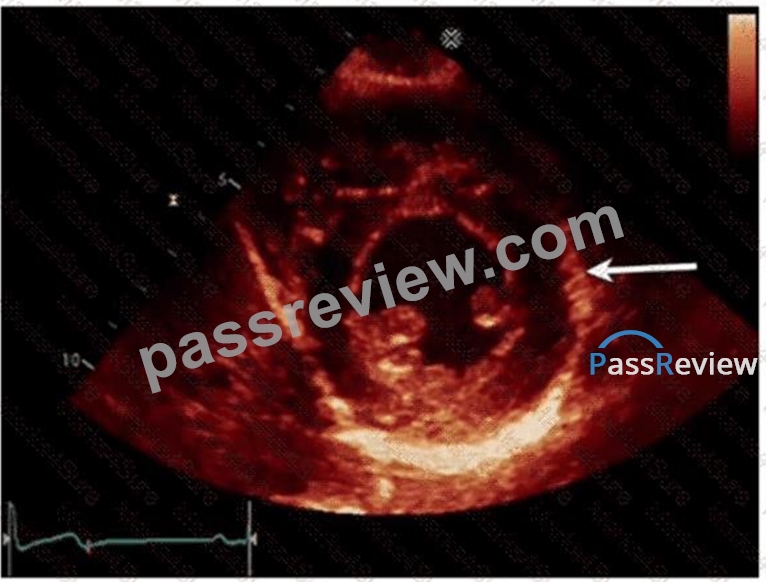
- A. Inferolateral
- B. Inferior
- C. Anterior
- D. Anterolateral
Answer: B
Explanation:
Comprehensive and Detailed Explanation From Exact Extract:
The echocardiographic image shows a short-axis view of the left ventricle at the mid-papillary muscle level with segmental strain values. The arrow points to the wall segment located inferiorly (towards the bottom of the image in standard orientation), which corresponds to the inferior wall of the left ventricle.
According to the standardized 17-segment model endorsed by the American Society of Echocardiography (ASE), the inferior wall is situated posteriorly and inferiorly in the short-axis view. The other options represent adjacent walls: anterior is opposite the inferior wall, anterolateral and inferolateral correspond to lateral wall segments.
This segmental anatomy and nomenclature are detailed in adult echocardiography textbooks and ASE chamber quantification guidelines, which emphasize precise segmental identification for accurate regional function assessment#12:ASE Chamber Quantification Guidelinesp.90-95##16:Textbook of Clinical Echocardiography, 6ep.140-145#.
NEW QUESTION # 44
......
AE Adult Echocardiography Examination exam is one of the top-rated ARDMS AE-Adult-Echocardiography Exams. This AE Adult Echocardiography Examination exam offers an industrial-recognized way to validate a candidate's skills and knowledge. Everyone can participate in AE Adult Echocardiography Examination exam requirements after completing the AE Adult Echocardiography Examination exam. With the AE Adult Echocardiography Examination exam you can learn in-demand skills and upgrade your knowledge. You can enhance your salary package and you can get a promotion in your company instantly.
AE-Adult-Echocardiography Valid Exam Notes: https://www.passreview.com/AE-Adult-Echocardiography_exam-copyright.html
- Newest AE-Adult-Echocardiography Questions Pdf - How to Download for AE-Adult-Echocardiography Valid Exam Notes Free of Charge ???? Open website “ www.testkingpass.com ” and search for ( AE-Adult-Echocardiography ) for free download ????AE-Adult-Echocardiography PDF Questions
- AE-Adult-Echocardiography Test Collection Pdf ???? AE-Adult-Echocardiography Reliable Exam Online ???? AE-Adult-Echocardiography Accurate Study Material ???? Copy URL “ www.pdfvce.com ” open and search for ☀ AE-Adult-Echocardiography ️☀️ to download for free ????Latest AE-Adult-Echocardiography Dumps Book
- Valid AE-Adult-Echocardiography Learning Materials ???? Certification AE-Adult-Echocardiography Exam Dumps ???? Valid AE-Adult-Echocardiography Learning Materials ???? Easily obtain 「 AE-Adult-Echocardiography 」 for free download through ▛ www.vce4dumps.com ▟ ????AE-Adult-Echocardiography Reliable Exam Online
- AE-Adult-Echocardiography Sample Test Online ???? AE-Adult-Echocardiography Training Pdf ???? AE-Adult-Echocardiography Reliable Exam Online ???? Search for ⏩ AE-Adult-Echocardiography ⏪ and download exam materials for free through [ www.pdfvce.com ] ????Free AE-Adult-Echocardiography Exam Questions
- New AE-Adult-Echocardiography Exam Notes ◀ Valid AE-Adult-Echocardiography Learning Materials ❇ New AE-Adult-Echocardiography Exam Notes ???? Search for ⏩ AE-Adult-Echocardiography ⏪ and easily obtain a free download on ✔ www.pass4test.com ️✔️ ????Latest AE-Adult-Echocardiography Dumps Book
- AE-Adult-Echocardiography Questions Pdf - Free PDF Quiz Realistic ARDMS AE Adult Echocardiography Examination Valid Exam Notes ???? Search on ( www.pdfvce.com ) for ➡ AE-Adult-Echocardiography ️⬅️ to obtain exam materials for free download ????AE-Adult-Echocardiography Dumps
- AE-Adult-Echocardiography Valid Exam Question ???? Latest AE-Adult-Echocardiography Dumps Book ⏹ AE-Adult-Echocardiography Test Collection Pdf ???? Search on ➥ www.easy4engine.com ???? for 「 AE-Adult-Echocardiography 」 to obtain exam materials for free download ⬛AE-Adult-Echocardiography Accurate Study Material
- AE-Adult-Echocardiography Dumps ???? AE-Adult-Echocardiography Accurate Study Material ???? AE-Adult-Echocardiography PDF Questions ???? Easily obtain free download of ⏩ AE-Adult-Echocardiography ⏪ by searching on [ www.pdfvce.com ] ????AE-Adult-Echocardiography Actual Test Pdf
- Valid AE-Adult-Echocardiography Learning Materials ☕ AE-Adult-Echocardiography Sample Test Online ???? Test AE-Adult-Echocardiography Engine ???? Search for 《 AE-Adult-Echocardiography 》 and obtain a free download on ▶ www.exam4labs.com ◀ ????AE-Adult-Echocardiography Training Pdf
- Valid AE-Adult-Echocardiography Learning Materials ???? AE-Adult-Echocardiography New Test Materials ???? Certification AE-Adult-Echocardiography Exam Dumps ???? Enter ☀ www.pdfvce.com ️☀️ and search for 《 AE-Adult-Echocardiography 》 to download for free ????AE-Adult-Echocardiography Passed
- Certification AE-Adult-Echocardiography Exam Dumps ???? AE-Adult-Echocardiography Exam Actual Tests ???? Test AE-Adult-Echocardiography Engine ⏫ Open ✔ www.examcollectionpass.com ️✔️ and search for ✔ AE-Adult-Echocardiography ️✔️ to download exam materials for free ????AE-Adult-Echocardiography Actual Test Pdf
- idafslz764725.wikifrontier.com, deweygewl804348.webbuzzfeed.com, sabrinaokun700639.glifeblog.com, aliciamots685179.bleepblogs.com, www.stes.tyc.edu.tw, jasonphbg529961.wikibuysell.com, successflyinginstitute.com, alexiamgon550171.myparisblog.com, chiarayhzu314608.blog-kids.com, sparxsocial.com, Disposable vapes
2026 Latest PassReview AE-Adult-Echocardiography copyright and AE-Adult-Echocardiography copyright Free Share: https://drive.google.com/open?id=1jd-qJLEJ4QQs8H16GMAjVtFF5RM_cd2j
Report this wiki page